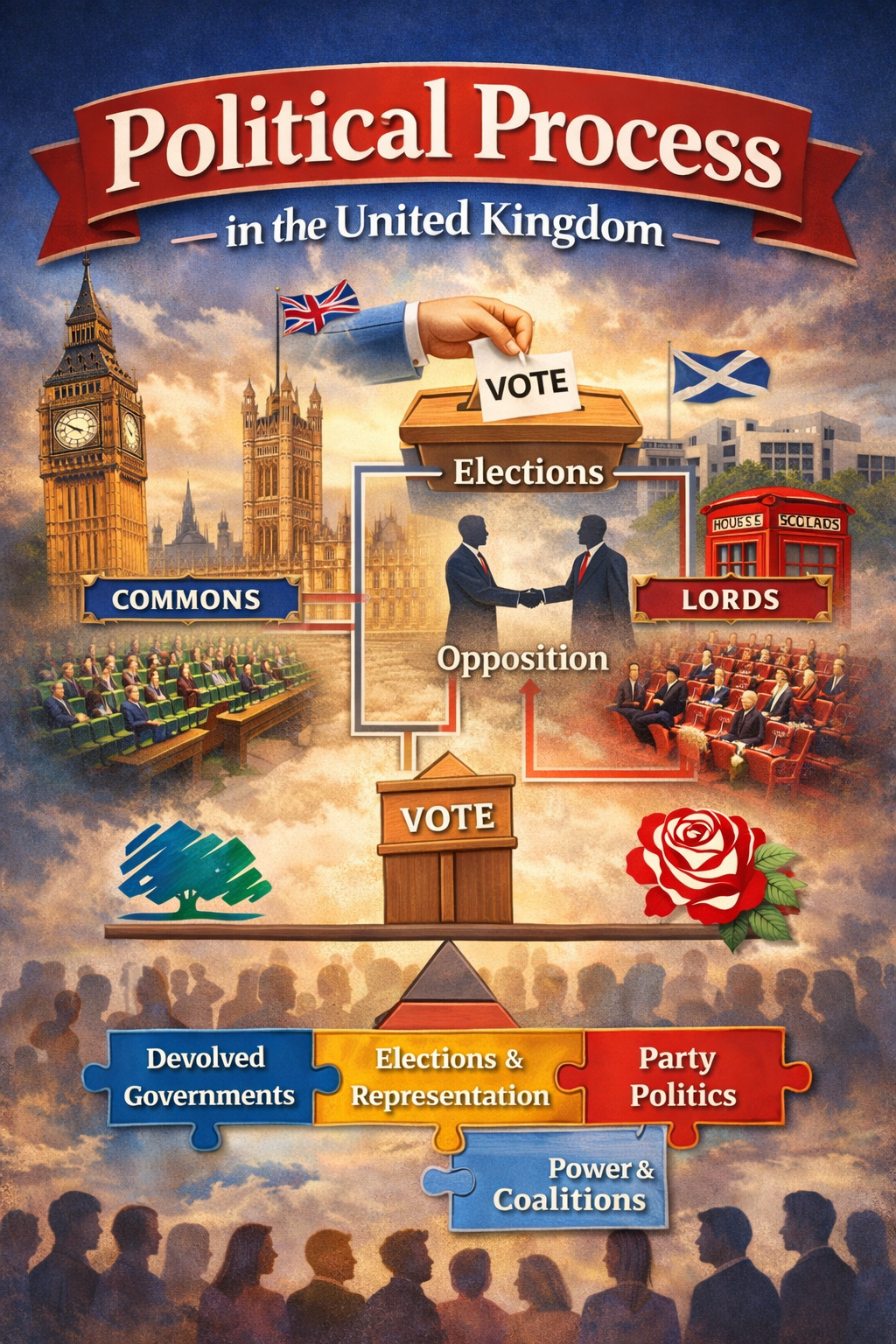
British politics can look deceptively calm from the outside.
There are no fireworks in Parliament. No presidential rallies that feel like stadium concerts. No elections every other month. The tone is quieter, the rituals older, and the vocabulary slightly strange.
But beneath that surface is one of the world’s longest-running democratic systems, shaped by tradition, reform, and constant negotiation between the four nations of the UK.
For Indians living in Scotland or elsewhere in Britain, understanding the political process is more than civics. It helps you decode:
- how decisions are made
- why elections feel different here
- what “constituency” means
- why Scotland has its own parliament
- how power shifts between parties
Let’s walk through the British political system clearly, without the fog of jargon.
Who can vote in the UK?
All citizens aged 18 or older are eligible to vote in parliamentary and local elections.
This includes elections for:
- Members of Parliament (MPs) in Westminster
- Local councils
- Devolved governments such as the Scottish Parliament (in relevant elections)
Unlike some countries, most major public posts beyond elections are filled by appointment, not direct voting.
Voting is one of the clearest ways migrants who become citizens participate in shaping the society they live in.
The House of Commons. The centre of political power
The UK Parliament has two chambers:
- House of Commons (elected)
- House of Lords (appointed)
The Commons is the dominant one.
Each MP represents a specific geographical area called a parliamentary constituency.
So when you vote in a general election, you are voting for the person who will represent your constituency in Parliament.
Constituencies and representation. Why Scotland used to have more MPs per person
Historically, constituency populations varied widely.
Scotland and Wales often had smaller constituencies than England, meaning they were somewhat overrepresented in Parliament.
This imbalance dates back to:
- Scotland’s union arrangements in the 18th century
- Wales’s representation adjustments in the 1940s
However, because Scotland gained significant devolved powers through the Scottish Parliament, this disparity was reduced.
In the May 2005 election, Scotland’s seats in the House of Commons were reduced from 72 to 59, bringing constituency size more in line with England.
Northern Ireland constituencies remain slightly smaller than England’s.
Also, MPs do not need to live in the constituency they represent, which can surprise newcomers.
How UK general elections work
A UK general election chooses the Members of Parliament.
The party that wins the most seats usually forms the government, and its leader becomes prime minister.
Elections are held at least every five years, because the House of Commons has a maximum term of five years.
Fixed-term Parliaments Act 2011. Changing the old system
Traditionally, the prime minister could ask the monarch to dissolve Parliament and call an election at almost any point within those five years.
This gave governments tactical advantage.
The Fixed-term Parliaments Act 2011 changed this by mandating a five-year interval between elections, allowing early elections only under special circumstances:
- A two-thirds majority vote in the House of Commons for an early election
- A successful no-confidence motion with no alternative government formed within 14 days
This reflects Britain’s constant balancing act between tradition and reform.
Voter registration and candidate selection
In the UK:
- voter registration is compulsory
- it is carried out annually
- candidates are normally selected by local party organisations
Unlike the United States, there are no primary elections in the American style.
This is partly because election timing has historically been unpredictable, making long primary seasons impractical.
Campaign rules. Why British elections feel short and restrained
British election campaigns are unusually brief and regulated.
Key features include:
- strict limits on candidate spending
- limits on national party spending (since 2000, capped at £20 million per party)
- free election broadcasts allocated on major TV channels
- no paid political advertising allowed on TV or radio
Televised leader debates became part of campaigns for the first time in 2010.
Compared with many democracies, UK elections are relatively inexpensive and compressed.
The politics may be intense, but the marketing is controlled.
The two-party tradition. Conservatives vs Labour
Since the late 17th century, the UK has largely operated under a two-party system.
Since the 1920s, the main rivals have been:
- Conservative Party
- Labour Party
However, smaller parties have gained representation, especially since the 1970s, including:
- Liberal Democrats
- Scottish National Party (SNP)
- Plaid Cymru (Welsh nationalists)
- Northern Irish unionist and nationalist parties
First past the post. The voting system that shapes everything
The UK uses a simple plurality system in single-member constituencies, often called:
First past the post
This means:
- the candidate with the most votes wins
- even if they do not have an absolute majority
This system tends to:
- exaggerate the majority of the winning party
- reduce representation for smaller parties
- favour regionally concentrated parties like SNP or Plaid Cymru
This is why UK politics often produces strong governments, but also debates about fairness and proportional representation.
Hung parliaments and coalition politics
Sometimes no party wins enough seats for a majority.
This is called a hung parliament.
In 2010, this happened, and the Liberal Democrats became the crucial coalition partner.
They also raised the possibility of changing the electoral system toward proportional representation, which would benefit smaller parties.
Coalition moments are rare but politically transformative.
The official opposition and the shadow government
One uniquely British concept is the official opposition.
The largest opposition party forms a “shadow government”, with shadow ministers prepared to take office if power shifts.
The leader of the opposition receives an official salary, recognising that the opposition is not simply resistance, but an alternative government-in-waiting.
This is one of the most structurally organised opposition systems in the world.
Women and minorities in British politics
Despite historic female monarchs, British politics was male dominated for centuries.
Breakthroughs were slow:
- only 29 women MPs in 1964
- Margaret Thatcher became the first female prime minister in 1979
- significant gains began in the 1990s
Labour introduced all-women shortlists in target seats, leading to 120 women elected in 1997 (101 Labour).
Minority representation has also increased:
- Jewish MPs have long been present
- Sikh and Muslim MPs have gained representation, though still limited historically
For Indian migrants, this evolution matters. Representation shapes belonging.
Why this matters for Indians in Scotland and the UK
For the Indian diaspora, British politics is not distant theatre.
It affects:
- immigration rules
- student policy
- NHS funding
- cost of living support
- Scotland’s devolved decisions
- multicultural inclusion
Understanding the political process helps migrants move from being residents to being informed participants in the society they live in.
Democracy is not just voting. It is comprehension.
A system shaped by tradition and constant change
The UK political process is a blend of:
- ancient institutions
- modern electoral rules
- regulated campaigns
- two-party dominance with rising regional voices
- evolving representation for women and minorities
It is not perfect. But it is structurally distinctive.
For Indians building a life in Scotland, learning how Britain governs itself is part of learning how Britain thinks.
And in a democracy, understanding is its own form of power.