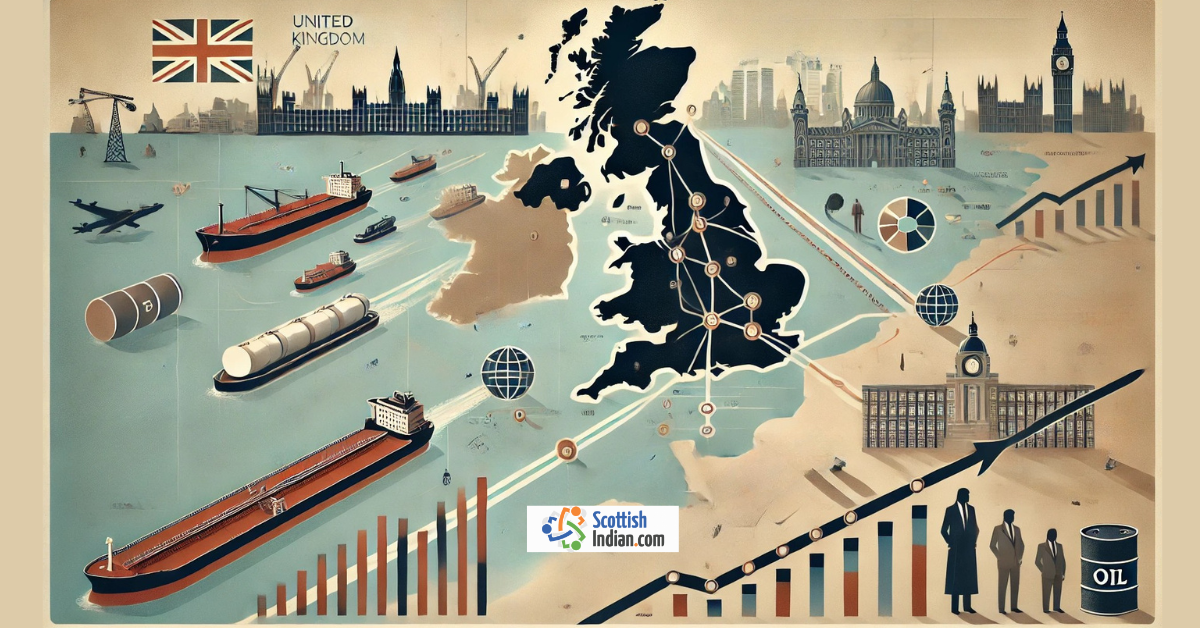
Global conflicts rarely remain confined to the regions where they occur. In an interconnected world economy, wars and geopolitical tensions can influence energy markets, trade routes, financial stability, and migration patterns across continents. For the United Kingdom, a major trading nation and financial centre, conflicts in regions such as Eastern Europe and the Middle East can have significant economic consequences.
Understanding how global conflicts affect the UK economy also helps explain shifts in energy prices, government spending, investment patterns, and even the cost of everyday goods. To better understand the broader economic structure of the country, you can read our guide on Finance and Government.
The UK’s Global Economic Connections
The UK is one of the world’s largest economies and a major hub for international finance, trade, and services. London’s financial markets connect businesses, investors, and governments across the globe. Because of these connections, geopolitical tensions often ripple through the British economy.
According to official statistics from the UK Office for National Statistics, international trade and services play a major role in the country’s economic output.
Global conflicts can affect the UK through several channels:
- Energy prices
- Trade disruptions
- Financial market volatility
- Government defence spending
- Migration and humanitarian responses
Events thousands of miles away can therefore have direct economic consequences in Britain.
Energy Markets and the Middle East
One of the most immediate ways global conflicts affect the UK economy is through energy markets. Although the UK produces some of its own energy, it still relies on international markets for oil and gas.
Many of these supplies originate in or pass through the Middle East, a region that holds a significant share of global oil reserves. Fluctuations in oil prices often follow geopolitical tensions.
Research and policy updates from the Bank of England show that energy price shocks can strongly influence inflation and household costs in the UK.
When oil prices increase, transportation, manufacturing, and electricity costs rise, which eventually affects consumers through higher prices.
The Role of Iran and Regional Powers in Middle East Conflicts
Iran plays a significant role in Middle Eastern geopolitics and regional power dynamics. As a major energy producer and influential regional actor, its relationships with neighbouring states shape the security environment of the region.
These dynamics are closely monitored by international organisations such as the International Monetary Fund, which regularly analyses how geopolitical tensions affect global economic stability.
Strategic Shipping Routes
One of the most important global trade routes is the Strait of Hormuz, through which a large portion of the world’s oil shipments travel. Tensions involving Iran in this region can raise concerns about disruptions to energy supply.
Even the possibility of conflict can lead to higher oil prices. This has a direct impact on the UK economy, affecting fuel prices, transportation costs, and inflation.
Regional Alliances and Rivalries
Iran’s relationships with regional powers—including Saudi Arabia and Israel—contribute to the complex geopolitical landscape of the Middle East.
These rivalries can influence global markets by creating uncertainty around energy supplies and trade routes. Economic analysis from institutions like the World Bank highlights how geopolitical instability often leads to fluctuations in energy prices and financial markets.
Defence Spending and Government Policy
Global conflicts also influence government spending priorities. When geopolitical tensions rise, countries often increase defence budgets and military preparedness.
The UK government regularly reviews defence strategy and spending commitments as part of its national security planning. Increased defence spending can support jobs in sectors such as aerospace, manufacturing, and technology.
However, higher defence spending can also place pressure on public finances, especially when governments must balance investments in infrastructure, healthcare, and education.
Financial Markets and Investor Confidence
London is one of the world’s leading financial centres, and global investors closely watch geopolitical developments.
During periods of international conflict, financial markets often become volatile. Investors may shift their funds into assets considered safer, such as government bonds or gold.
These changes can affect:
- Currency exchange rates
- Stock market performance
- Investment decisions by businesses
Because of London’s global financial influence, geopolitical tensions often have immediate effects on UK financial markets.
Trade and Supply Chains
Modern supply chains stretch across multiple continents. Global conflicts can interrupt these networks by damaging infrastructure, restricting shipping routes, or triggering economic sanctions.
For example, disruptions in major maritime routes can delay shipments of raw materials and manufactured goods. British businesses that rely on imported components may face higher costs or slower production.
Migration and Humanitarian Effects
Conflicts often lead to humanitarian crises and displacement of populations. Countries affected by war may see large numbers of refugees and migrants seeking safety abroad.
Migration can influence labour markets, housing demand, and public services in the UK. At the same time, migrants can contribute positively to economic growth by filling labour shortages in key sectors such as healthcare, construction, and hospitality.
Opportunities in Times of Global Change
While conflicts bring uncertainty, they can also reshape economic opportunities.
For example:
- Increased investment in renewable energy may reduce dependence on volatile energy markets.
- Defence and cybersecurity industries may experience growth due to rising security needs.
- Financial services may expand as companies seek expertise in risk management.
If you are interested in the sectors driving growth, explore our guide on Moving and settling in the UK.
A Global Economy Shaped by Geopolitics
The UK economy does not operate in isolation. Events in regions such as Eastern Europe and the Middle East can influence energy prices, trade flows, and financial markets across the world.
Conflicts involving regional powers, including Iran, demonstrate how geopolitical tensions can ripple through global economic systems. For the UK, these impacts can appear in everyday realities from the price of fuel to government spending priorities.
Understanding these global connections helps explain why international conflicts matter not only for diplomacy and security, but also for the economic lives of people living and working in Britain.