Moving to the United Kingdom can feel a little like arriving in one country and then slowly realising it contains several worlds inside it.
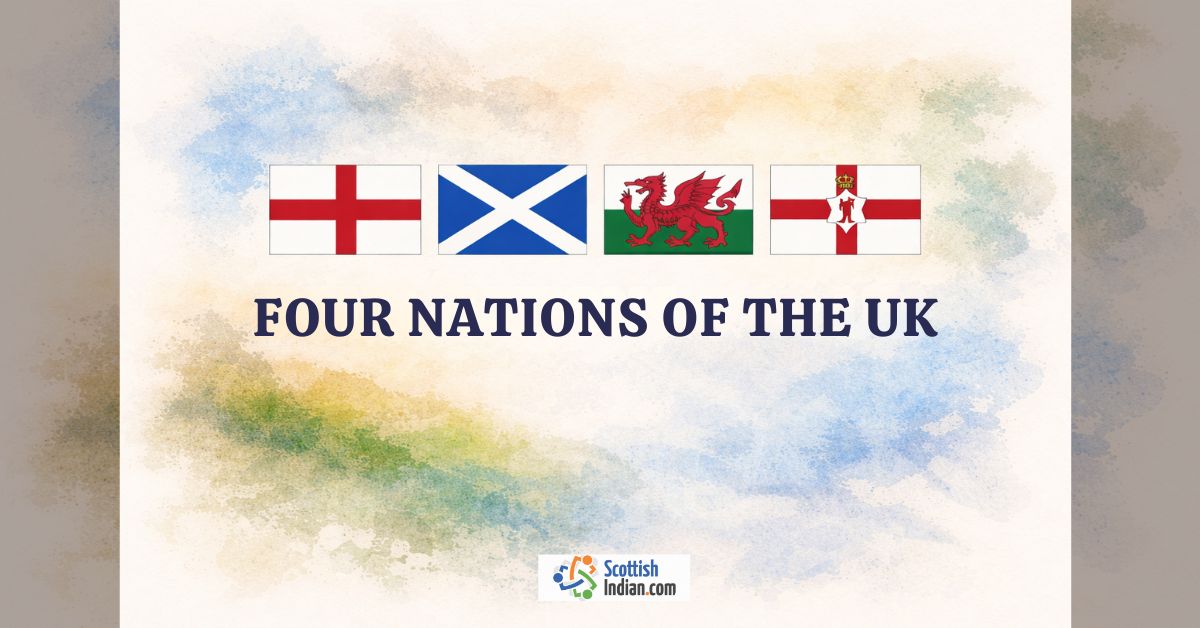
People say “the UK” as if it’s one simple place. But the United Kingdom is actually made up of four distinct nations. Each has its own history, identity, traditions, accents, and cultural rhythm.
For Indians in Scotland and across Britain, understanding this matters. It helps you settle in better, connect more deeply, and appreciate the richness of the place you now call home.
At ScottishIndian.com, we explore these everyday cultural shifts often in our diaspora life section, where we map what belonging looks like between India and UK.
So let’s explore the UK properly, not as one uniform culture, but as a fascinating patchwork of four nations.
The United Kingdom. One state, four nations
The United Kingdom of Great Britain and Northern Ireland includes:
- England
- Scotland
- Wales
- Northern Ireland
Geographically, England, Scotland, and Wales share the island of Great Britain, while Northern Ireland sits on the island of Ireland.
This is why the terms can be confusing:
- Great Britain = the island (England, Scotland, Wales)
- United Kingdom = the sovereign country (all four nations)
It’s one political union, but culturally, it’s far from one single identity.
England. Tradition, modern diversity, and global influence
England is the largest and most populous nation in the UK, and much of what the world thinks of as “British culture” is often actually English culture.
This is where you find:
- London’s global energy
- Shakespeare, classic literature, and historic universities
- Traditional customs like afternoon tea
- A deep blend of old institutions and modern multicultural life
For Indian migrants, England often feels like the centre of opportunity, especially in cities like London, Birmingham, Leicester, and Manchester, where South Asian communities have shaped local culture for decades.
Many Indians first arrive in England before moving north, which is why we also cover immigration and settlement guidance across Britain.
Official population figures from the Office for National Statistics show how England remains the largest nation by population within the UK.
English identity today is a mix of heritage and constant reinvention, influenced heavily by immigration and global exchange.
Scotland. A nation of pride, poetry, and powerful traditions
Scotland, for many Indians living here, feels distinct almost immediately.
There’s a strong national identity rooted in:
- Celtic history
- Highland landscapes
- A separate legal and education system
- Cultural traditions that are proudly preserved
Scottish culture is globally recognised through symbols like:
- Kilts and tartan
- Bagpipes and folk music
- Burns Night and Scotland’s poetic legacy
- Hogmanay, one of the world’s most famous New Year celebrations
Languages like Scots Gaelic and Scots remain part of the cultural fabric, especially in the Highlands and Islands.
Scotland’s distinct voice is also supported politically through devolution, with the Scottish Parliament holding powers over many domestic issues.
For diaspora communities, Scotland often offers something rare. A smaller country with a deep sense of story, where belonging is shaped through community, not just scale.
Wales. A living Celtic language and cultural resilience
Wales is sometimes overlooked by newcomers, but it holds one of the strongest cultural identities in the UK.
The Welsh language, Cymraeg, is not symbolic. It is living, spoken, taught, and protected.
Wales is known for:
- Strong musical traditions
- Poetry and folk heritage
- National festivals like the Eisteddfod
- A deep pride in language and land
For Indian visitors, Wales can feel like a quieter cultural world. Rural, lyrical, and rooted in community traditions that stretch back centuries.
It’s a reminder that modern Britain still contains ancient voices.
Northern Ireland. Complex identity, cultural depth, and resilience
Northern Ireland’s culture is shaped by a unique and sometimes difficult history.
It is part of the UK, but it also holds deep connections to Irish heritage. Identity here can be layered, shaped by:
- British influences
- Irish traditions
- Local community life
- A strong artistic and literary presence
Northern Irish culture is expressed through:
- Traditional music and dance
- Festivals and parades
- Contemporary arts and storytelling
- A growing global cultural confidence
For migrants, Northern Ireland offers an important lesson. Culture is not always simple. It can be shaped by history, memory, and resilience.
What unites the UK. Shared systems, diverse lived cultures
Despite their differences, the four nations share:
- A constitutional monarchy
- Parliamentary democracy
- English as the dominant language
- National institutions like the NHS
- A deeply multicultural modern society
Immigration, including from India, Pakistan, Bangladesh, and Sri Lanka, has reshaped the UK into something far more diverse than older stereotypes suggest.
The UK today is not just “British”. It is British-Asian, Afro-Caribbean, Arab-British, European-British, and much more.
Each constituency elects a Member of Parliament, and the UK Parliament website explains how general elections shape national representation.
And that diversity plays out differently in each nation.
For many Indians, shared institutions like the NHS are one of the first common systems experienced across the UK.
Why this matters for Indians living in Britain
At ScottishIndian.com, we often say that living abroad is not just about visas, jobs, or weather. It’s about cultural literacy.
Understanding the four nations helps you:
- Feel less confused by regional identity
- Connect more respectfully with local traditions
- Appreciate Scotland beyond just “the UK”
- Travel with deeper awareness
- See Britain as layered, not flat
For Indians who become eligible to vote or participate civically, the UK government provides a clear guide to elections and democratic systems.
For Indians in Scotland especially, recognising Scotland’s distinct voice within the UK is part of truly belonging here.
The United Kingdom is not culturally uniform. It is a union of four nations, each contributing something irreplaceable:
- England’s global influence
- Scotland’s proud heritage
- Wales’s linguistic resilience
- Northern Ireland’s complex depth
To explore the UK’s structure in more detail, Britannica’s official UK profile is a valuable reference.
Together, they form a kingdom that is politically united but culturally rich, diverse, and beautifully uneven.
And for the Indian diaspora, that unevenness is the point. It’s where the stories begin.